MasterSeries Blog
How Composite Beams Actually Work: Load Sharing Between Steel and Concrete
Composite beams are often described very simply: the concrete carries compression, the steel carries tension, and shear studs connect the two.
While this description is correct, it does not fully explain what is happening inside the beam or why this combination is so efficient.
To understand composite beam design properly, it helps to think less about two separate materials sitting on top of one another and more about the transfer of forces between them.
At their core, composite beams work by exploiting the compressive strength of concrete and the tensile strength of steel so that both materials act together as a single structural unit. In this system, the steel beam provides the tension force required for bending resistance, while the concrete slab carries most or all of the compression force. A composite beam works because the steel beam and the concrete slab are connected strongly enough to transfer forces between them.
Once the two elements are connected properly, the result is a member that is stronger, stiffer, and often more material-efficient than a non-composite steel beam.
What Changes When a Beam Acts Compositely
A standard steel beam under gravity loading bends, with compression at the top and tension at the bottom. The steel section resists both forces on its own. While this works well, it does not use the concrete slab often positioned above the beam in a floor system. It increases the load but does not significantly enhance the beam’s bending resistance.
Once the slab is connected to the top flange using shear connectors, usually headed shear studs, the behaviour changes completely. When the beam bends under sagging moment, the concrete slab acts in compression, while the steel beam continues to resist tension. Instead of the steel section resisting the entire bending effect alone, the internal forces are shared between the steel and the concrete.
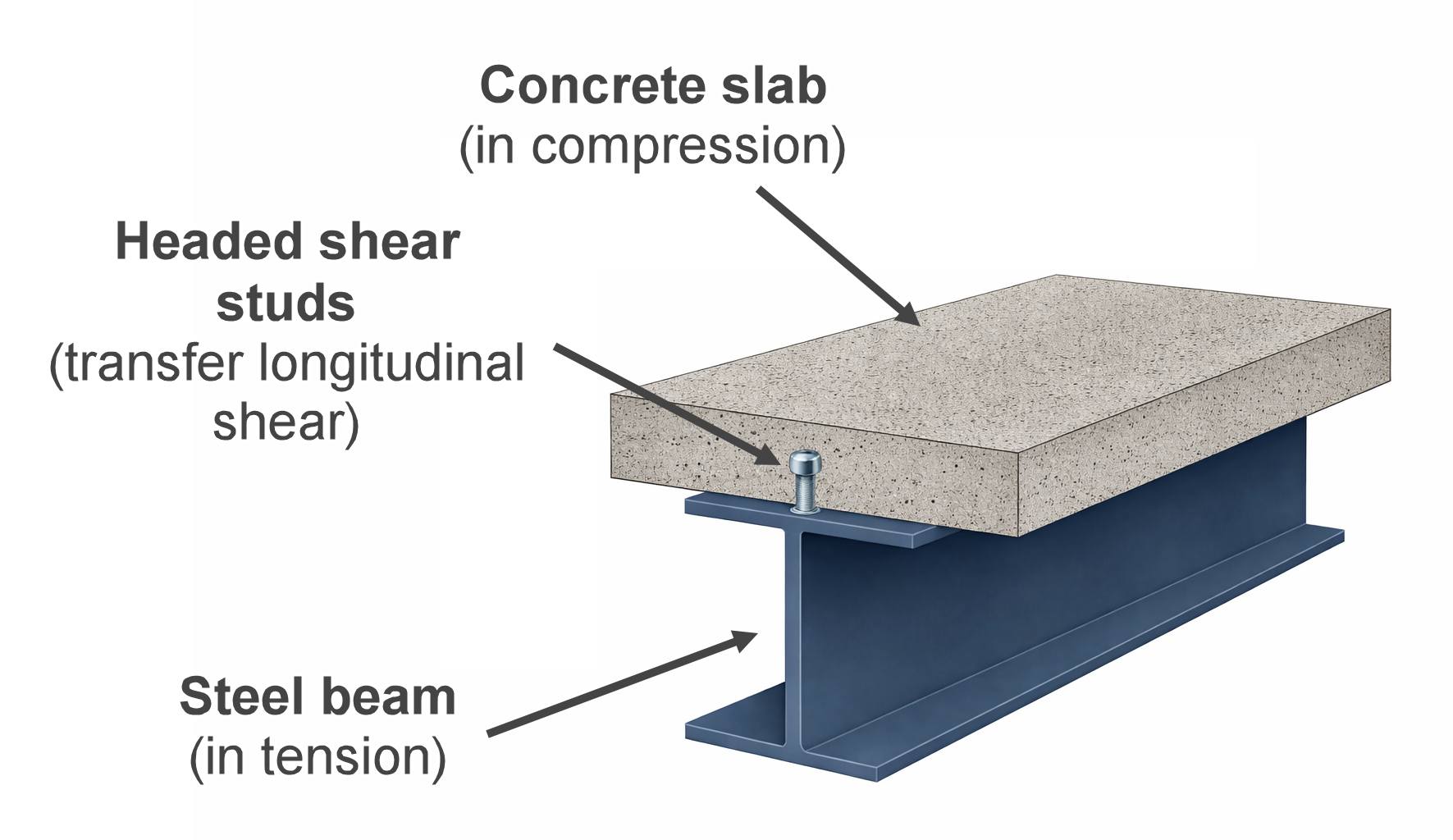
This interaction forms the basis of composite action. The slab and the beam are not simply in contact. They are forced to deform together closely enough that longitudinal shear can be transferred across the interface. This allows compression to develop in the concrete and tension to develop in the steel in a coordinated way.
Load Sharing Between Steel and Concrete
The key to load sharing in a composite beam is shear transfer.
As the beam bends, the steel section and concrete slab naturally want to slip past one another. Shear connectors, usually headed studs welded to the top flange of the steel beam, resist this movement by transferring longitudinal shear across the interface.
This shear transfer is what enables composite action. By forcing the steel beam and concrete slab to deform together, the connectors allow an internal force couple to develop in a coordinated way:
- The concrete slab carries most or all of the compression force
- The steel beam carries most or all of the tension force
In regions of positive (sagging) bending, the slab therefore becomes the compression component of the section, while the steel beam primarily resists tension.
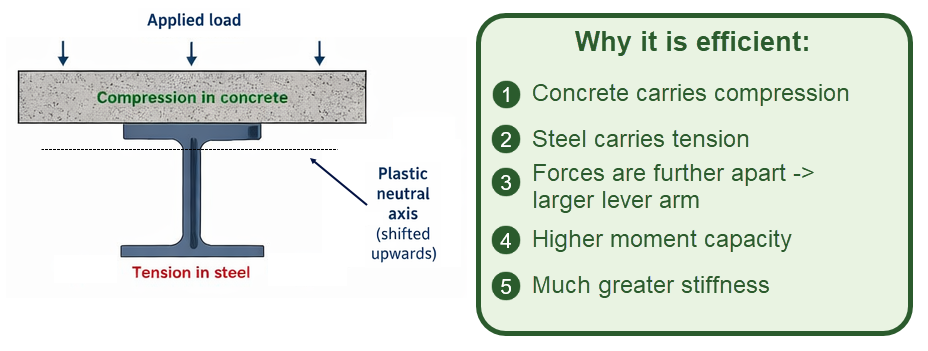
Once connected, the concrete slab effectively acts as a wide compression flange, while the steel beam forms the web and tension element. This is why a composite beam is often described as behaving like a structural T-beam.
Because the compression force in the slab and the tension force in the steel are further apart, the internal lever arm increases. This increased lever arm is one of the main reasons composite beams are more efficient than steel beams acting alone, leading to both higher bending resistance and greater stiffness.
This redistribution shifts the plastic neutral axis upward, often into the concrete slab or near the steel beam’s top flange.
Overall, because the steel beam and concrete slab are forced to act as a single structural member, the composite section can achieve significantly higher performance than either material acting alone. In practice, composite action can substantially increase both the load-carrying capacity (by up to 2 times) and stiffness of the beam (by up to 3.5 times) compared with a non-composite steel beam (based on guidance in SCI P300).
Why Composite Action Is Efficient
Composite construction is efficient because it uses each material where it performs best.
Concrete is strong in compression but weak in tension. Steel is strong in both, but is especially effective in tension.
Composite construction takes advantage of that. Once connected, the concrete slab acts as a wide compression flange, while the steel beam acts as the web and primary tension element. This is why composite beams are often described as behaving like a structural T section.
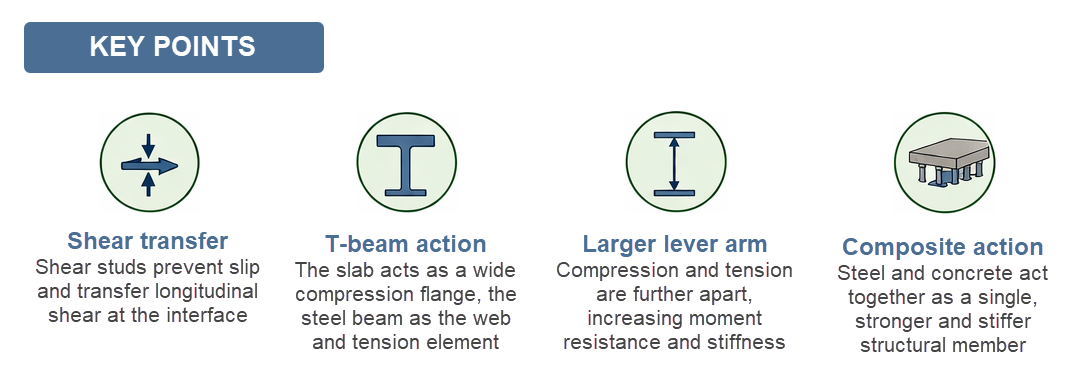
Because the compression force in the slab and the tension force in the steel are further apart, the internal lever arm increases. That means greater moment resistance can be developed from the same materials, which is one of the main reasons composite beams are more efficient than steel beams acting alone.
Composite action also significantly increases stiffness, improving deflection performance. In addition, the slab can provide restraint to the top flange of the steel beam, which helps the beam act more efficiently in bending.
The Role of Shear Studs
A slab does not help a beam simply because it sits on top of it. It only contributes when there is enough connection for force to be transferred between the two parts.

Headed shear studs are welded to the top flange of the steel beam and embedded in the concrete slab. Their role is to transfer longitudinal shear and limit slip at the interface. The studs do not resist vertical loads directly. Instead, they transfer longitudinal shear forces between the steel beam and the slab.
Without that shear transfer, the slab cannot properly develop its compression role, and the beam cannot achieve full composite behaviour.
Full vs Partial Shear Connection
Full shear connection
Full shear connection occurs when there are sufficient shear connectors to develop the required force transfer, allowing the beam to reach its maximum composite bending resistance. Beyond this point, adding more studs will not increase moment capacity.
Partial shear connection
In many practical designs, the number of studs is limited by factors such as deck rib spacing, detailing, or economy. In these cases, the total available stud resistance governs the amount of force that can be transferred between the steel and concrete, so the beam develops only part of its full composite resistance.
This does not mean the beam is ineffective. A partial shear connection is often sufficient and can be the most practical and economical solution. The beam still acts compositely, but its resistance is limited by the available shear connection rather than the full potential of the steel and slab acting together.
Why the Construction Stage Matters
Load sharing in a composite beam does not begin immediately.
During construction, the bare steel beam must support its own weight, the decking, and the weight of the wet concrete. At this stage, the concrete has not hardened and provides no composite benefit.
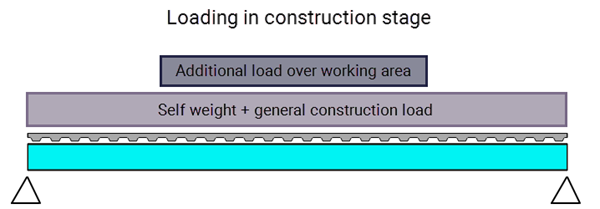
Only after the concrete has cured do the shear connectors become effective, allowing the slab and beam to act together. From that point onward, additional loads such as finishes, services, partitions, and occupancy loads are resisted by the composite section.
This staged behaviour is an important part of composite beam design because the beam may need to be checked differently before and after composite action develops.
Conclusion
A composite beam is not just a steel beam with concrete placed on top of it. It is a connected structural system designed so that steel and concrete can each contribute where they are most effective.
The concrete slab provides compression resistance. The steel beam provides tension resistance. The shear studs transfer the longitudinal shear forces that allow the two elements to act together.
This interaction is what allows composite beams to achieve higher strength, greater stiffness, and longer spans than steel beams acting alone, which is why they are widely used in modern steel building construction.
Try Composite Beam Design with MasterBeam
Designing composite beams can involve many interacting checks — from load sharing and shear connection design to deflection control and construction stage behaviour. MasterBeam: Composite Design simplifies this process with a powerful yet highly intuitive design environment built specifically for structural engineers.
The program allows you to quickly design primary, secondary, and mixed primary-secondary composite beams, with or without web openings, while automatically handling the complex interaction between the steel section, concrete slab, and shear connectors.
Flexible workflows
- Standalone design tool – ideal for quick composite beam design and optimisation.
- Integrated Building Design workflow – use it as part of the Building Design Suite to design composite floors directly within a complete 3D structural model.
Whether you are designing a single beam or an entire floor system, MasterBeam: Composite Design streamlines calculations, automates code checks, and presents clear engineering results.
See it in action
- Learn more: https://www.masterseries.com/p...
- Request a free trial: https://www.masterseries.com/f...
- Book a live demo with one of our engineers: https://www.masterseries.com/d...
Start exploring how MasterBeam: Composite Design can simplify and accelerate your composite beam design workflow.
Categories
- About
- Beam Designer
- BIM
- Composite design
- Concrete Design
- Connections
- Dynamic
- Educational
- General
- LCA
- Masonry
- MasterFrame
- Pile Cap
- Portals
- PowerPad
- Retaining wall
- Steel Design
- Webinar
- Wind Analysis