MasterSeries Blog
Designing Wall Panels on a Domestic Property with MasterSeries' Masonry Yield Line Analysis & Design [Webinar Recording]
Masonry construction still holds significant importance in the building industry because of its durability, versatility, and cultural significance. Although the design of masonry wall panels is still often based on traditional simplified methods, modern design methods can make significant savings in money and materials.
Watch the recording of our webinar and learn how MasterSeries Masonry Design can increase your efficiency and help you to deliver complex and economical building solutions.
In this video, we look at the design of several types of Cavity Wall Panels within MasterSeries Masonry Design Module, for a typical domestic semi-detached style property.
The introduction covers a very brief introduction to the Yield Line Theory, as an analysis method for the design of efficient masonry wall panels, covering how the traditional method of flexural strength design to British Standards and Eurocode 6 actually derives from the Yield Line theory.
We then proceed to go through the setup and designs of 11 different wall panels, taking into consideration various factors such as
Loading:
- Vertical UDLs (from floors / roofs and wall panels)
- Vertical Point Loads (from steel beams)
- Horizontal In-Plane Loads (racking)
- Horizontal Out-of-Plane Wind Loads (wind)
- Dealing with multiple Openings
- Introducing Wall Reinforcement (wall piers and wind posts)
- Various Free / Continuous / Pinned Fixity Conditions including DPM
Major Updates - 2025 Release
Since the posting of this webinar, we have made some high changes to the Advanced Masonry Design Software module.
We have transitioned in the 2025 version from the restrictive traditional "sub-panel" method to a whole-wall Advanced Yield Line Analysis,. This modernization fundamentally changes how masonry walls are analyzed and introduces several major new features and fixes:
Complex Geometries and Whole-Wall Design
- Non-Rectangular Walls: You can now model complex, non-rectangular shapes, including symmetric and asymmetric gables, as well as hipped roofs, treating them as a single cohesive structural unit rather than artificially slicing them into rectangles.
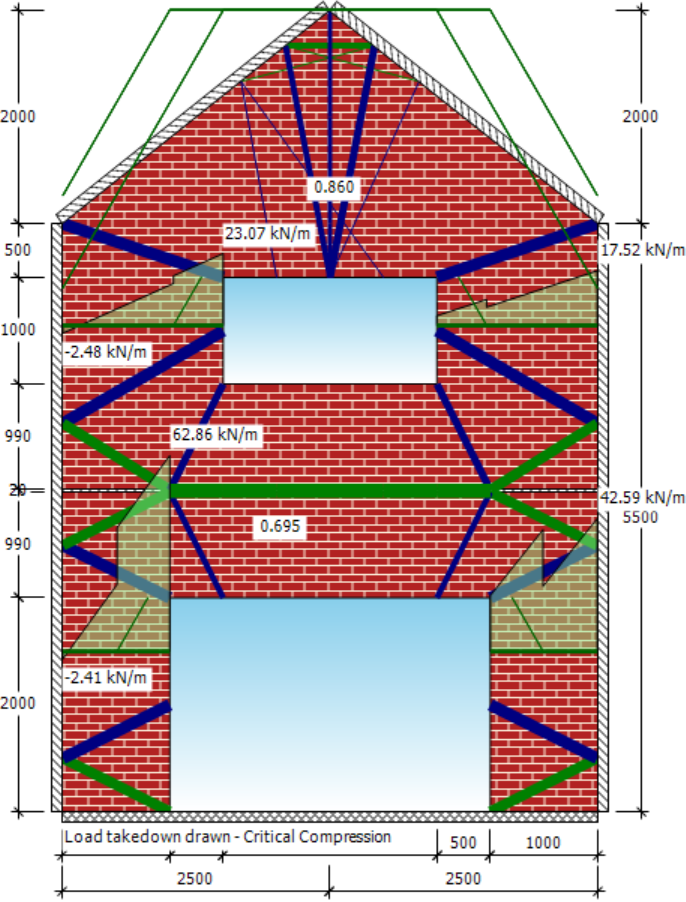
- Multi-Story Walls & Internal Supports: The module natively supports multi-story continuous walls,. Users can map internal lateral supports, such as intermediate horizontal floor ties or vertical return walls, which divide the yield-line analysis into separate behavior domains.
- Multi-Level Buckling Checks: The software now automatically tracks vertical load takedown through these multi-story geometries, performing rigorous buckling checks on the localized vertical strips interacting with the loads above them.
Advanced Load Placement and Reinforcement
- Anywhere Point & Line Loads: Point loads and newly introduced partial line loads can now be mapped explicitly using exact X and Y coordinates anywhere on the wall panel, removing the old limitation that forced point loads to only be applied at the top edge.
- Bed Joint Reinforcement: If a masonry zone is overstressed, a new workflow allows you to seamlessly apply horizontal bed joint reinforcement (including proprietary products like Murfor) to specific courses. The module automatically recalculates and boosts the tensile capacity to rescue the failing wall,.
- Second-Generation Eurocodes: The module has been updated to align with the newly released second-generation Eurocode 6 and its UK National Annex,.
📥 Download our FREE 14-day MasterSeries trial using the following link 📥
https://www.masterseries.com/f...
⏰ Timecodes ⏰
00:00 Overall Introduction and Agenda
01:20 Background of Yield Line Analysis within the Masonry Design Module
04:33 Introduction to Example: Semi-Detached Property
05:00 Front Wall Panels 1 - 4
10:00 Wall Panel 5 - Comparison Between Yield Line Analysis and Traditional Methods
10:55 Wall Panel 7 & 8
12:03 Wall Panel 9 - Panel with 2 openings and a Point Load from a Beam and behaviour of Yield Line Analysis using Wind Posts vs Stiffened Piers
19:06 Rear Wall Panels 10 & 11 Including Resisting In-Plane Shear Forces and Moments from Adjacent Walls
23:55 Outro
Categories
- About
- Beam Designer
- BIM
- Composite design
- Concrete Design
- Connections
- Dynamic
- Educational
- General
- LCA
- Masonry
- MasterFrame
- Pile Cap
- Portals
- PowerPad
- Retaining wall
- Steel Design
- Webinar
- Wind Analysis