MasterSeries Blog
What's New in MasterSeries: Continuous Development Throughout the Release Cycle
Releasing a new major version is only one part of MasterSeries' development.
As outlined in our 2nd Generation Eurocode Roadmap, we have dedicated a significant proportion of our development resources during the current cycle to preparing MasterSeries for the transition to the 2nd Generation Eurocodes. This substantial programme of work involves reviewing and implementing the new standards as they are published, along with the associated changes required across our analysis and design modules.
However, development of MasterSeries has continued alongside this major programme of work. Since the initial launch of MasterSeries 2025 in August 2025, regular software updates have delivered new analysis capabilities, design enhancements, technical improvements, updated manufacturer data, interoperability features and usability improvements. This means that customers have continued to receive new functionality throughout the 2025 release cycle, even though the major version number has remained unchanged.
The developments highlighted in this blog post represent some of the key changes delivered since the initial MasterSeries 2025 release.
For the full technical details, including the version in which each enhancement was introduced, see the MasterSeries 2025 Release Notes.
More powerful analysis and modelling
The development cycle has introduced a range of enhancements to MasterFrame and the underlying analysis engines, providing greater flexibility and control for structural analysis.
Non-linear member axial and moment limits
MasterFrame now supports predefined axial and moment limits for members, with automatic force redistribution when these limits are reached.
- The new Axial Limit member attribute allows a maximum tensile or compressive axial force to be specified. When an axial limit is reached, MasterFrame automatically performs a non-linear analysis and redistributes forces using a Newton-Raphson iterative approach.
- A new Moment Limit attribute similarly allows users to specify a member’s plastic moment capacity. This can be used with second-order plastic analysis where potential plastic hinges are placed.
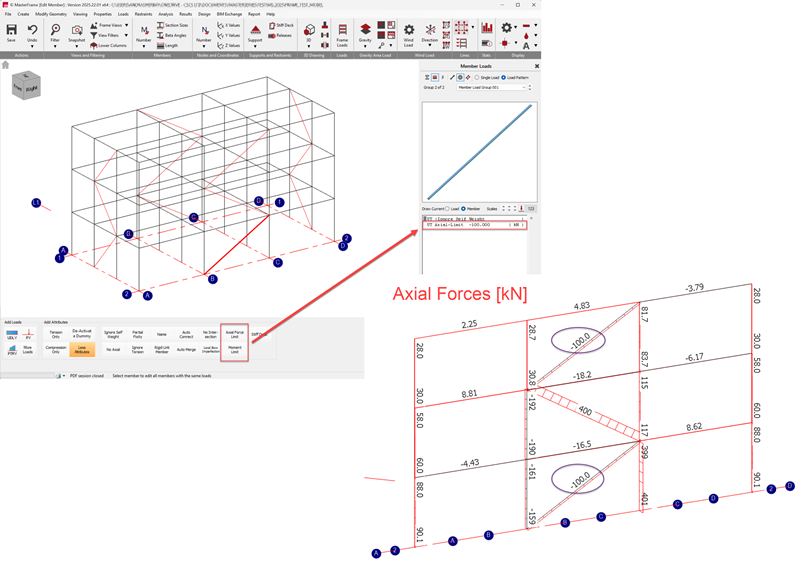
These capabilities provide additional control when modelling structures where members are expected to reach defined plastic capacities and forces must redistribute through the structure.
Simpler alternate loading for FE analysis
The setup of alternate loading for finite element analysis has been simplified.
Permanent loads, including self-weight and applied surface dead loads, can now remain on standard load groups, while only variable loads need to use the alternate load type. This reflects the Eurocode approach to load patterning and simplifies load case setup, while reducing the likelihood of errors from missing alternate load regions.
Stable Node IDs
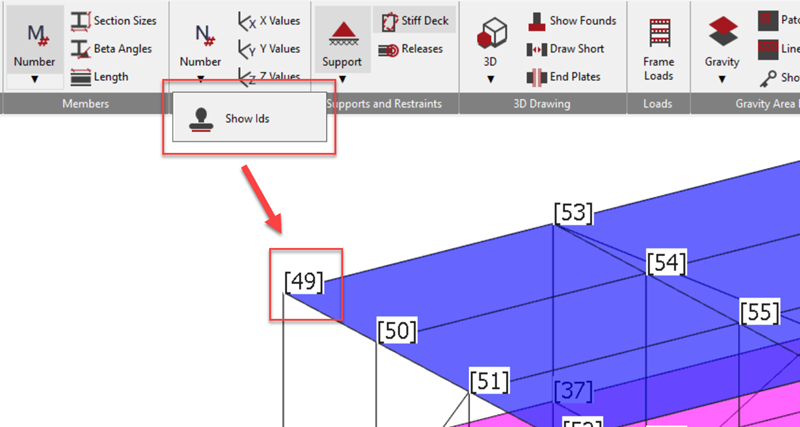
New Node IDs provide a stable reference for individual nodes within a model.
Unlike analysis node numbers, which can change when the model is re-analysed, Node IDs remain associated with the node. They can also be used in tabular and design output, making it easier to identify and reference nodes consistently throughout the design process.
Greater control over FE load distribution
MasterFrame now allows users to control the resolution used when distributing patch and line loads through area loading panels.
The default resolution is 0.1 m, but you can now reduce it to 0.025 m where greater control is required. This is particularly useful where loads cross multiple panels or members, and the distribution between them needs finer control.
Further analysis developments
Other analysis and modelling improvements delivered during the cycle include:
- User-defined response spectra for Dynamic Response Spectrum Analysis
- Calculation of effective X, Y and Z directional mobilised mass for each mode shape, with MS Excel export
- Separate FE meshing controls for columns and walls
- Load case labels on envelope results, showing the load case governing maximum and minimum values
- Support for the 10,000-year wind site risk factor in the SCIPHYR site-wide analysis engine
- Inclusion of FE shear wall forces in the EC3 elastic critical load factor (αcr) assessment
These developments give users greater control over analysis setup and provide additional information to review and interpret analysis results.
Steel, composite and connection design improvements
We also made a range of refinements to steel member, composite, and connection design.
Improvements to steel member design
The development cycle has also included a number of refinements to steel member design, including:
- Updated design of haunched and tapered steel members
- An option to ignore the local bow imperfection check for the Axial + Moment design brief
- Updated treatment of minor-axis local bow with second-order analysis
More flexibility in composite design
Composite design now allows a concrete grade of 0 to be assigned to a design brief to force non-composite design within the composite design module.
Auto design can also set this automatically where the minimum degree of shear connection is difficult to achieve and non-composite design is more appropriate.
Updated composite deck libraries
The composite metal deck libraries have been expanded and updated with new manufacturer profiles.
We added new Kingspan Multideck V3 products, including Multideck 50, 60 and 80 V3 with 450 N/mm² yield strength.
Several SMD composite metal deck profiles have also been added or updated, including:
- R51+ S350 and S450
- TR60+ S350 and S450
- TR80+ S350 and S450
- TR220 S350

The composite deck input has also been enhanced with a new Trough Top Nib Height parameter. This information can favourably affect the calculated degree of shear connection and make the minimum degree of shear connection easier to achieve.
Updated splice connection calculations
Second-order movements within splice connections now follow the Eurocode approach described in AD 471.
Additional base plate prying checks
MasterSeries now performs additional checks for base plate prying forces under conditions where neglecting prying action may not be appropriate.
The checks cover thinner plates, larger bolt lever arms, or larger bolt diameters, providing additional verification of the base plate design in accordance with the relevant Eurocode provisions.
Further connection design improvements
- Additional countersunk bolt plate thickness checks
- Updated definitions and controls for close-tolerance bolt holes in splice connections
Concrete and masonry design
Several enhancements have also been introduced across the concrete and masonry design modules.
Crack width calculations for pile caps
A new option provides a rigorous crack width calculation for pile caps in accordance with EN 1992-1-1:2004, Clause 7.3.3.
This adds a further serviceability check to pile cap design where crack width assessment is required.
Improvements to concrete column effective lengths
The calculation of column effective length factors k1 and k2 has been refined for EN 1992-1-1:2004 column design.
The calculation now adjusts nodal rotations relative to the overall column rotation where required, addressing cases where the original rotation relationship could produce larger effective length factors and therefore longer calculated effective lengths.
Masonry design improvements
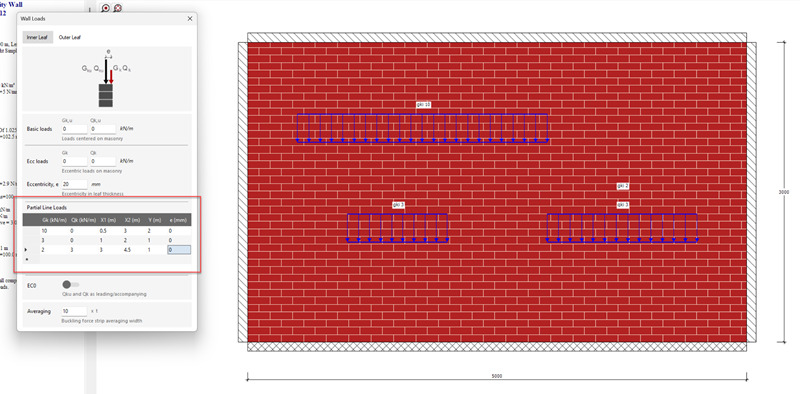
Masonry design now supports multiple partial uniformly distributed loads at any Y location within the wall height.
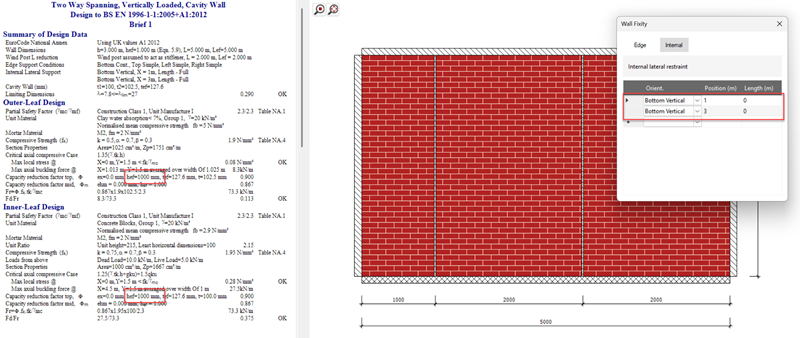
Vertical internal lateral supports are also now taken into account when calculating effective height values.
BIM Improvement
MasterSeries can now import curved beams from Tekla Structures, extending the interoperability between the two applications for models containing curved structural members.
Development continues
The updates delivered during the MasterSeries 2025 cycle reflect two parallel areas of development.
A major focus has been the extensive work required to prepare MasterSeries for the 2nd Generation Eurocodes, as described in our Eurocode roadmap. At the same time, development has continued across the existing software, delivering new analysis capabilities, design refinements, updated libraries, interoperability improvements and usability enhancements.
Here's the complete list of New Features and Improvements during the 2025 major version cycle.
Categories
- About
- Beam Designer
- BIM
- Composite design
- Concrete Design
- Connections
- Dynamic
- Educational
- General
- LCA
- Masonry
- MasterFrame
- Pile Cap
- Portals
- PowerPad
- Retaining wall
- Steel Design
- Webinar
- Wind Analysis